Always Strive . . .


"To raise new questions, new possibilities, to regard old problems from a new angle, requires creative imagination and marks real advance in science."

Albert Einstein

Thursday, March 30, 2017

Chapter 11 Test 'The Atmosphere' Scheduled for April 11th--Tuesday

Hello Parents!

Here is a copy of the Study Guide for the upcoming test covering Chapter 11 'The Atmosphere.'  Your child has a hard copy.  Thank you!  Mrs. Stafford

Chapter 11 Study Guide

What is weather?
Answer:  Weather is the condition of Earth’s atmosphere at a particular time and place.

What is the Earth’s atmosphere?
Answer:  The Earth’s atmosphere is the envelope of gases that surrounds the planet.

What does the Earth’s atmosphere consist of?
1)    Nitrogen
2)    Oxygen
3)    Carbon Dioxide
4)    Water Vapor
5)    Other Gases (plus particles of liquids and solids)

What is the most abundant gas in the atmosphere, and how much of the air we breathe is this gas?
Answer:  Nitrogen is the most abundant gas.  It makes up a little more than ¾ of the air we breathe.

True or False???
Nitrogen occurs in all living things.           TRUE!!!

True or False???
Nitrogen makes up 3% of the weight of the human body.   TRUE!!!

What is the second most abundant gas in the atmosphere, and how much of the air we breathe is this gas?
Answer:  Oxygen is the second most abundant gas in the atmosphere.  It makes up only about 21% of the volume.

How do plants and animals use oxygen?
Answer:  Plants and animals take oxygen directly from the air and use it to release energy from their food.

Is carbon dioxide essential for life?
Answer:  Yes, it is!

Why is carbon dioxide essential for life?
Answer:  Plants must have carbon dioxide to produce food, and the cells of animals break down food and give off carbon dioxide as a waste product.

How much of the atmosphere is made up of carbon dioxide?
Answer:  Less than 1% of the atmosphere is made up of carbon dioxide.

What is argon?
Answer:  Argon is the remaining gases (trace gases) that make up the 1% of the atmosphere’s dry air.  Oxygen and nitrogen make up the other 99%.

Is air dry?
Answer:  No, air contains water vapor—water in the form of a gas.

How is the atmosphere a system?
Answer:  The atmosphere interacts with other Earth systems, such as the ocean.  The atmosphere has many different parts.  Some of the parts can be seen-like clouds.  Other parts cannot be seen-like air, wind, and energy.

True or False???
Energy from the sun drives the motions in the atmosphere.   TRUE!!!

Does air have mass?
Answer:  Yes!  It consists of atoms and molecules which have mass.

What properties, other than mass, does air have?
Answer:  Air has density and air pressure. 

Why doesn’t air pressure crush us?
Answer:  The molecules in air push in all directions---down, up, and sideways.

What instruments measure air pressure?
Answer:
1)    A barometer is an instrument that measures air pressure.
The two types of barometers are:
a)     Mercury Barometer—It consists of a long glass tube that is closed at one end and open at the other.  The open end rests in a dish of mercury.  The closed end of the tube is almost a vacuum---the space above the mercury contains very little air.  Air pressing down on the surface of the mercury in the dish is equal to the pressure exerted by the weight of the column of mercury in the tube.  When the air pressure increases, it presses down more on the surface of the mercury.  Greater air pressure forces the column of mercury higher.  So, the level of the mercury in the tube shows you the pressure of the air that day.
b)    Aneroid Barometer---It is an airtight metal chamber sensitive to changes in air pressure.  When air pressure increases, the thin walls of the chamber are pushed in.  When air pressure decreases, the thin walls bulge out.

True or False???
Most weather reports for the general public use inches of mercury.  TRUE!!!
BUT----the National Weather Service maps indicate air pressure in millibars. 
The pressure of the atmosphere is equal to one bar. 
One inch of mercury is equal to about 33.86 millibars.

What is altitude?
Answer:  Altitude is elevation, or the distance above sea level.

True or False???
Air pressure decreases as altitude increases.  As air pressure decreases, so does density.         TRUE!!!

True or False???
Since the air is less dense at a high altitude, each cubic meter of air you breathe has fewer oxygen molecules than at sea level.  So, you would become short of breath more quickly at a high altitude.  TRUE!!!

What are the four main layers of the atmosphere?
Answer:      1)  the troposphere
2)  the stratosphere
3)  the mesosphere
4)  the thermosphere

What two layers make up the thermosphere?
Answer:  The ionosphere and the exosphere are the two layers of the thermosphere.

What does ‘tropo’ mean?
Answer:  ‘Tropo’ means turning or changing.


What occurs in the troposphere?
Answer:  Weather occurs in the troposphere.

What is the altitude of the troposphere?
Answer:  The altitude is 0-12 km.

What does ‘strato’ mean?
Answer:  ‘Strato’ means layer or spread out.

What is contained in the stratosphere?
Answer:  The ozone layer is contained in the stratosphere.

What is the ozone layer?
Answer:  The ozone layer is a form of oxygen that has three atoms in each molecule instead of the usual two.  When ozone absorbs energy from the sun, the energy is converted into heat, warming the air.  The ozone layer protects living things from ultraviolet radiation from the sun.

What is the altitude of the stratosphere?
Answer:  The altitude is 12-50 km.

What does ‘meso’ mean?
Answer:  ‘Meso’ means middle, so the mesosphere is the middle layer of the atmosphere.

What is the altitude of the mesosphere?
Answer:  The altitude is 50-80 km.

What occurs in the mesosphere?
Answer:  Meteoroids are burned up in the mesosphere, thus the Earth’s surface is protected.

What is the thermosphere?
Answer:  The thermosphere is the outermost layer of the Earth’s atmosphere.

What occurs in the thermosphere?
Answer:  Auroras happen here.  Even though the temperature is up to 1800 degrees Celsius, it doesn’t feel warm because molecules are far apart. 


What does visible light include?
Answer:  Visible light includes all of the colors that you see in a rainbow:  red, orange, yellow, green, blue, and violet.

What colors have the longest wavelengths?
Answer:  Red and orange light have the longest wavelengths.

What colors have the shortest wavelengths?
Answer:  Blue and violet light have the shortest wavelengths.

Is infrared radiation visible by humans?
Answer:  No, it is not visible by humans, but can be felt as heat.

True or False????
Clouds act as mirrors, reflecting sunlight back into space.    TRUE!!!

What is scattering?
Answer:  Dust-size particles and gases in the atmosphere disperse light in all directions.

What percentage of the energy that reaches Earth’s surface is absorbed by land and water and changed into heat?
Answer:  50%

What is the greenhouse effect?
Answer:  The sun’s energy reaches Earth.  Earth’s surface is heated.  Some heat is radiated into space.  Some radiated heat is absorbed by gases in the atmosphere.  The greenhouse effect keeps Earth’s atmosphere at a temperature that is comfortable for most living things.

What is temperature?
Answer:  Temperature is the average amount of energy of motion of each particle of a substance.

What unit is temperature measured in?
Answer:  Temperature is measured in degrees.

What are the two scales used to measure temperature?
Answer:  Celsius and Fahrenheit are the two scales used to measure temperature.

What is the freezing point of Celcius?
Answer:  0 degrees C

What is the boiling point of Celcius?
Answer:  100 degrees C

What is the freezing point of Fahrenheit?
Answer:  32 degrees F

What is the boiling point of Fahrenheit?
Answer:  212 degrees F

Name three ways heat is transferred from a hotter object to a cooler one.
Answer: 1)  convection     2)  conduction    3)  radiation

What is convection?
Answer:  Convection is the transfer of heat by the movement of a fluid.

What is conduction?
Answer:  Conduction is the transfer of heat between two substances that are in direct contact.

What is radiation?
Answer:  Radiation is the direct transfer  of energy by electromagnetic waves.  Most of the heat you feel from the sun travels to you as infrared radiation.  You can’t see it, but you can feel it.

True or False?????
Radiation, conduction, and convection work together to heat the troposphere.  TRUE!!!

Heat is transferred mostly by what within the atmosphere?
Answer:  Heat is transferred mostly by convection currents within the atmosphere.

What are convection currents?
Answer:  The upward movement of warm air and the downward movement of cool air form convection currents.

What is wind?
Answer:  Wind is the movement of air parallel to Earth’s surface.
What causes the air to move?
Answer:  Differences in air pressure cause movement in the air.

What causes most differences in air pressure?
Answer:  Most differences in air pressure are caused by unequal heating of the atmosphere.

How is wind speed measured?
Answer:  Wind speed is measured with a tool called an anemometer.

What is an anemometer?
Answer:  An anemometer has three or four cups mounted at the ends of spokes that spin on an axle.  The force of the wind against the cups turns the axle.  A meter connected to the axle shows the wind speed.

What is the windchill factor?
Answer:  The increased cooling that a wind can cause is called the windchill factor.

What are local winds?
Answer:  Winds that blow over short distances are called local winds.

True or False?????
The unequal heating of Earth’s surface within a small area causes local winds.  TRUE!!!!!

What are two types of local winds?
Answer:  A sea breeze and a land breeze are two types of local winds.

What is a sea breeze?
Answer:  A sea breeze or a lake breeze is a local wind that blows from an ocean or lake.

What is a land breeze?
Answer:  The flow of air from land to a body of water forms a land breeze.

What are global winds?
Answer:  Global winds are winds that blow steadily from specific directions over long distances.


What is the Coriolis Effect?
Answer:  The way the Earth’s rotation makes winds curve is called the Coriolis Effect.

Name the global wind belts.
1)    Doldrums-a calm area where warm air rises (occurring at the equator).
2)    Horse Latitudes-two calm areas of sinking air. At about 30 degrees north and south latitudes, the air stops moving towards the poles and sinks.
3)    Trade Winds-blow from the horse latitudes toward the equator.
4)    Prevailing Westerlies-blow from west to east, away from the horse latitudes.
5)    Polar Easterlies-blow cold air away from the poles.


Wednesday, February 22, 2017

Completed "Water Cycle" Projects Proudly Displayed

The class did an amazing job with their "Water Cycle" projects!  I am so proud of them!  Today each student explained the process while showing us their projects!  Excellent Work, Class!


Chapter 10 Tests Scheduled---Study Guides Below

Hello Parents!

Chapter 10 is a very long chapter with a lot of information.  I will be giving two tests in order to cover the material, but not overwhelm the children.  The first test will be on Wednesday, March 1st.  It will cover Chapter 10  Lessons 1-3.  The second test will be on Tuesday, March 7th.  It will cover Chapter 10  Lessons 4-6.  Both Study Guides are below.  Your children have a hard copy of the first Study Guide, but will not be given the second one until after they take the test next Wednesday.  I don't want to risk confusion.  Please let me know if you have any questions!

Blessings,

Beth Stafford

Study Guide – Chapter 10—Water
Lessons 1, 2, and 3

Why is water important?
Answer:  Water makes up nearly two-thirds of your body’s mass.  That water is necessary to keep your body functioning.

What body processes does water help with?
1-breaking down food
2-grow
3-reproduce
4-get and use materials they need from their environments

What is a habitat?
Answer:  A habitat is the place where a living thing lives and obtains all the things it needs to survive.

True or False?
Most of Earth’s surface water – nearly 97 percent – is salt water found in oceans.  Only 3 percent is fresh water.   TRUE!!!!!

Of the 3 percent of fresh water, how much is frozen in huge masses of ice near the North and South Poles?
Answer:  2/3 is frozen      

Which is the largest ocean?
Answer:  The Pacific Ocean is the largest, covering an area greater than all the land on Earth.

What is groundwater?
Answer:  Groundwater is the water that fills the cracks and spaces in underground soil and rock layers. 

True or False?
Far more fresh water is located underground than in all of Earth’s rivers and lakes.    TRUE!!!!!

What are the four main sources of fresh water on Earth?
Answer:  1) ice, 2) rivers, 3) lakes, and 4) groundwater

What are the major steps of the water cycle?
Answer:
1)      Evaporation – is the process by which molecules at the surface of a liquid absorb enough energy to change to a gaseous state.
2)      Transpiration – Water is given off through the leaves as water vapor.
3)      Condensation – is the change in state from a gas to a liquid.
4)      Precipitation – Any form of water that falls from clouds and reaches Earth’s surface as rain, snow, sleet, or hail.
What is a tributary?
Answer:  The streams and smaller rivers that feed into a main river are called tributaries.

True or False?????
Tributaries flow downward toward the main river, pulled by the force of gravity.  TRUE!!!

What is a watershed?
Answer:  The land area that supplies water to a river system is called a watershed.

True or False?????
Watersheds are sometimes known as drainage basins.   TRUE!!!

What is a divide?
Answer:  A ridge of land that separates one watershed from another is called a divide.

What is the longest divide in North America?
Answer:  The Great Divide (also called the Continental Divide) is the longest divide in North America.

What makes a lake or pond different from a river?
Answer:  Unlike streams and rivers, ponds and lakes contain still water.

Where does pond and lake water come from?
Answer:  Ponds and lakes form when water collects in hollows and low-lying areas of land.

Name ways that lakes can be formed.
1)      Depressions created by ice sheets can form lakes.
2)      Movements of Earth’s crust that formed long, deep valleys called rift valleys.
3)      Volcanoes can form lakes—lava and mud from the volcano block a river.
4)      Lakes can also be formed in the empty craters of volcanoes.
5)      People can create a lake by building a dam.

What is a lake that stores water for human use called?
Answer:  A lake that stores water for human use is called a reservoir.

Which is usually deeper, a lake or a pond?
Answer:  a lake

What can cause lakes to disappear?
Answer:  Natural processes and human activities can cause lakes to disappear.

What is eutrophication?
Answer:  Eutrophication is the buildup over time of nutrients in freshwater lakes and ponds that leads to an increase in the growth of algae.


What is a water table?
Answer:  The water table is the top of the saturated layer.

What are permeable materials?
Answer:  Rock and soil that have large and connected pores (sand and gravel) allow water to pass through.  These are permeable.

What are impermeable materials?
Answer:  Materials that have few or no pores or cracks, or the pores are very small or unconnected, are impermeable (clay and granite) or will NOT allow water to pass through.

Explain what a water zone is.
Answer:  Water from precipitation soaks down through permeable rock and soil layers.  These layers contain air as well as water, so they are not saturated, or filled, with water.  The top layer is thus called the unsaturated zone.  At some depth, the water reaches a level where the pores in the ground are saturated with water. This is called the saturated zone. THE TOP OF THE SATURATED ZONE IS THE WATER TABLE!

What is an aquifer?
Answer:  An aquifer is any underground layer of permeable rock or sediment that holds water and allows it to flow.

What are three ways people can get water from an aquifer?
1)      Springs-Springs are formed as groundwater bubbles or flows out of cracks in the rock.
2)      Wells-People bring groundwater to the surface for drinking and other everyday use by drilling a well below the water table.
3)      Artesian wells-Water rises on its own because of pressure within an aquifer.


                                                    Study Guide – Chapter 10
Lessons 4, 5, 6,

What 3 ways does the water in Earth’s oceans vary?
1)      Salinity
2)      Temperature
3)      Depth

What is salinity?
Answer:  Salinity is the total amount of dissolved salts in a sample of water.

At what temperature does salt water freeze?
Answer:  -1.9 degrees Celcius

At what temperature does fresh water freeze?
Answer:  0 degrees Celcius

True or False???
As you descend through the ocean, the water temperature decreases.   TRUE!!!!!

What is sonar?
Answer:  Sonar (Sound Navigation Ranging) uses sound waves to calculate the distance to an object.

What are six major ocean floor features?
1)      trench—a long, deep valley on the ocean floor through which old ocean floor sinks back towards the mantle
2)      continental slope—the steep edge of the continental shelf
3)      continental shelf--a gently sloping, shallow area that extends outward from the edge of each continent
4)      abyssal plain—a broad area covered with thick layers of mud and silt—it is usually a smooth, nearly flat region of the ocean
5)      mid-ocean ridges—long chains of mountains on the ocean floors
6)      seamount--a volcanic mountain rising from the ocean floor that doesn’t reach the surface

True or False???
Most waves form when winds blowing across the water’s surface transmit their energy to the water.   TRUE!!!!!

What is a wave?
Answer:  A wave is the movement of energy through a body of water.

What is the highest part of a wave?
Answer:  The crest is the highest part of a wave.


What is a wavelength?
Answer:  A wavelength is the horizontal distance between crests.

What is the ‘frequency’ of a wave?
Answer:  The number of waves that pass a point in a certain amount of time.

What is wave height?
Answer:  The vertical distance from the crest to the trough is the wave height.

What is the lowest part of a wave called?
Answer:  The lowest part of a wave is called a trough.

True or False?????
Near shore, wave height increases and wavelength decreases.   TRUE!!!!!

What is a tsunami?
Answer:  A tsunami is a type of wave that is usually caused by an earthquake beneath the ocean floor.

Why do waves change as they approach shore?
Answer:  The waves become shallower.  The bottoms of the waves begin to touch the sloping ocean floor.  Friction between the ocean floor and the water causes the waves to slow down.  As the speed of the waves decreases, their shapes change.

True or False?????
Waves usually roll toward shore at an angle.   TRUE!!!!!

What is a longshore drift?
Answer:  A longshore drift is the movement of sand along the beach.  As the waves slow down, they deposit the sand they are carrying on the shallow, underwater slope, forming a long ridge called a sandbar.

What is a rip current?
Answer:  A rip current is a rush of water that flows rapidly back to sea through a narrow opening in a sandbar.

How do waves shape a beach?
Answer:  Waves shape a beach by eroding the shore in some places and building it up in others.

What is a groin?
Answer:  A groin is a wall of rocks or concrete used to reduce beach erosion.

What are surface currents driven by?
Answer:  Surface currents are mainly driven by wind.


What is the Coriolis Effect?
Answer:  The Coriolis Effect is caused by the Earth’s rotation causing an effect on the direction of winds and currents. 

How do currents in the Northern Hemisphere move when effected by the Coriolis Effect?
Answer:  The currents curve clockwise.

How do currents in the Southern Hemisphere move when effected by the Coriolis Effect?
Answer:  The currents curve counterclockwise.

What is the largest and most powerful surface current in the North Atlantic Ocean?
Answer:  The Gulf Stream is the largest and most powerful surface current in the North Atlantic Ocean.

What is climate?
Answer:  Climate is the pattern of temperature and precipitation typical of an area over a long period of time.

What is El Niño?
Answer:  El Niño is a climate event that occurs every two to seven years in the Pacific Ocean.  It causes shifts in weather patterns due to an unusual pattern of winds forming over the western Pacific.

What is La Niña?
Answer:  La Niña  is a climate event that occurs when surface waters in the eastern Pacific are colder than normal.  It usually brings colder than normal winters and greater precipitation to the Pacific Northwest and north central United States.

True or False?????
Cold water is more dense than warm water.   TRUE!!!!!

What causes deep currents?
Answer:  Deep currents are caused by differences in the density of ocean water.

True or False?????
Deep currents move and mix water around the world.  They carry cold water from the poles toward the equator.    TRUE!!!!!


Tuesday, February 7, 2017

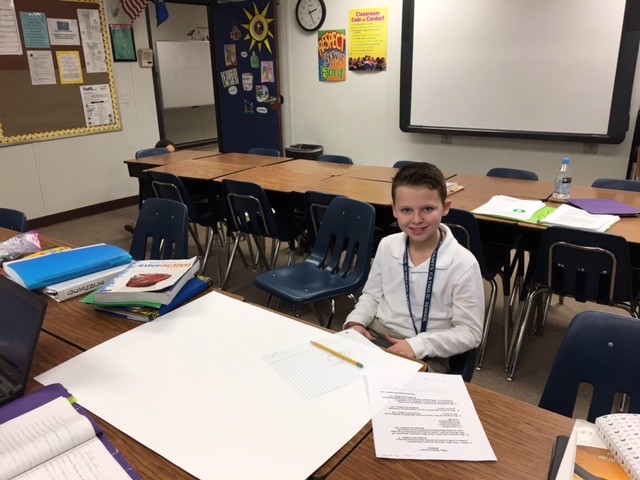
Students Busy Working on Their "Water Cycle" Posters


'The Water Cycle' Rubric---Project is Due on Friday, February 10th!!!

“The Water Cycle”
Rubric


1.  Title:  The title of your poster should be
written and centered at the top of your poster.
                                                          Points Possible:  5

2.   The poster should correctly contain all parts of
The Water Cycle, and each part should be neatly and clearly illustrated (drawn and colored). 
                                                          Points Possible:  50
*evaporation
*condensation
*precipitation
*transpiration
*runoff

3.   Each part of The Water Cycle should be defined on the poster.                                      Points Possible:  25

4.   The poster should be neat, organized, colorful, and creative.                             Points Possible:  15

5.  All wording should be spelled correctly.  Definitions should be written in complete sentences with proper grammar and punctuation.
Points Possible:  15

Total Points Possible: 110