Wednesday, December 2, 2015


Wednesday, November 18, 2015
Examining Rocks to Determine Type is Great Fun!
Today the sixth grade Earth Science students first watched an Edible Geology video about how to make the three types of rocks: igneous, metamorphic, and sedimentary. We will be making those rocks next week (AND EATING THEM, AS WELL)! :)
Afterwards, we examined different samples of rocks to determine which type of rock each was. Students used what they have learned about how geologists classify rocks. They looked at mineral composition, color, and texture of each sample through a magnifying glass. Then, they recorded the name of the rock, its classification, and wrote a brief description. Also, they were provided a chart showing the life cycle of a rock in order to understand exactly where their samples fall in that cycle.


Afterwards, we examined different samples of rocks to determine which type of rock each was. Students used what they have learned about how geologists classify rocks. They looked at mineral composition, color, and texture of each sample through a magnifying glass. Then, they recorded the name of the rock, its classification, and wrote a brief description. Also, they were provided a chart showing the life cycle of a rock in order to understand exactly where their samples fall in that cycle.


Friday, November 6, 2015
Students Having Fun While Learning Earth Science
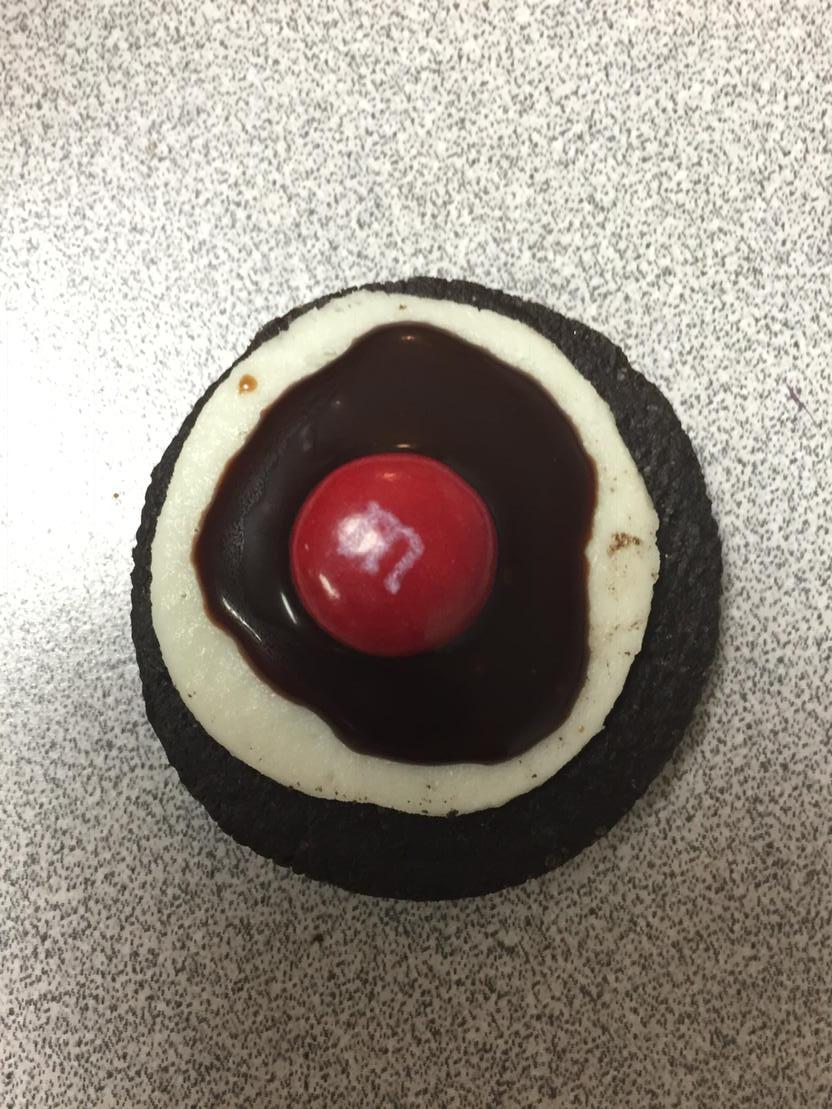
While our class has super intelligent students (83% class average on the Plate Tectonics Test--Woo! Hoo!), we still try to learn by doing (kinesthetically)! Earlier this week we reviewed the layers of the Earth by doing an experiment involving Oreo cookies, Hershey Chocolate Syrup, and M&Ms! First, students took the Oreo apart. They ate the side having only the chocolate cookie. The other side of the cookie, which included the cream filling, represented the crust (outer thin layer of cookie) and the mantle (cream filling). Next, we added Hershey Syrup in the middle which represented the molten outer core, and a M&M was placed in the center (the solid inner core). What a fun way to remember the layers of the Earth and have a delicious snack, as well!
Wednesday, October 21, 2015
Chapter 3 Test Covering 'Plate Tectonics' Scheduled
Hello!
Students will be taking a test covering Chapter 3, 'Plate Tectonics', on Tuesday, October 27th! We will be reviewing for the test on Monday. A study guide will be provided.
Have a wonderful break!
Mrs. Stafford
Students will be taking a test covering Chapter 3, 'Plate Tectonics', on Tuesday, October 27th! We will be reviewing for the test on Monday. A study guide will be provided.
Have a wonderful break!
Mrs. Stafford



Wednesday, October 7, 2015
Students Learn About Alfred Wegener's Hypothesis About Pangaea
In 1910, Alfred Wegener, a German scientist, became curious about why some continents look like they could fit together. Wegener's hypothesis was that all the continents were once joined together in a single landmass he named Pangaea. His idea was that the continents slowly moved over the Earth's surface. This became known as continental drift.
Wegener said this supercontinent, Pangaea, was joined together about 300 million years ago. Over tens of millions of years, Pangaea began to break apart, and the pieces of Pangaea slowly moved to their present locations. These pieces became the continents as formed today.

Wegener said this supercontinent, Pangaea, was joined together about 300 million years ago. Over tens of millions of years, Pangaea began to break apart, and the pieces of Pangaea slowly moved to their present locations. These pieces became the continents as formed today.
Subscribe to:
Posts (Atom)